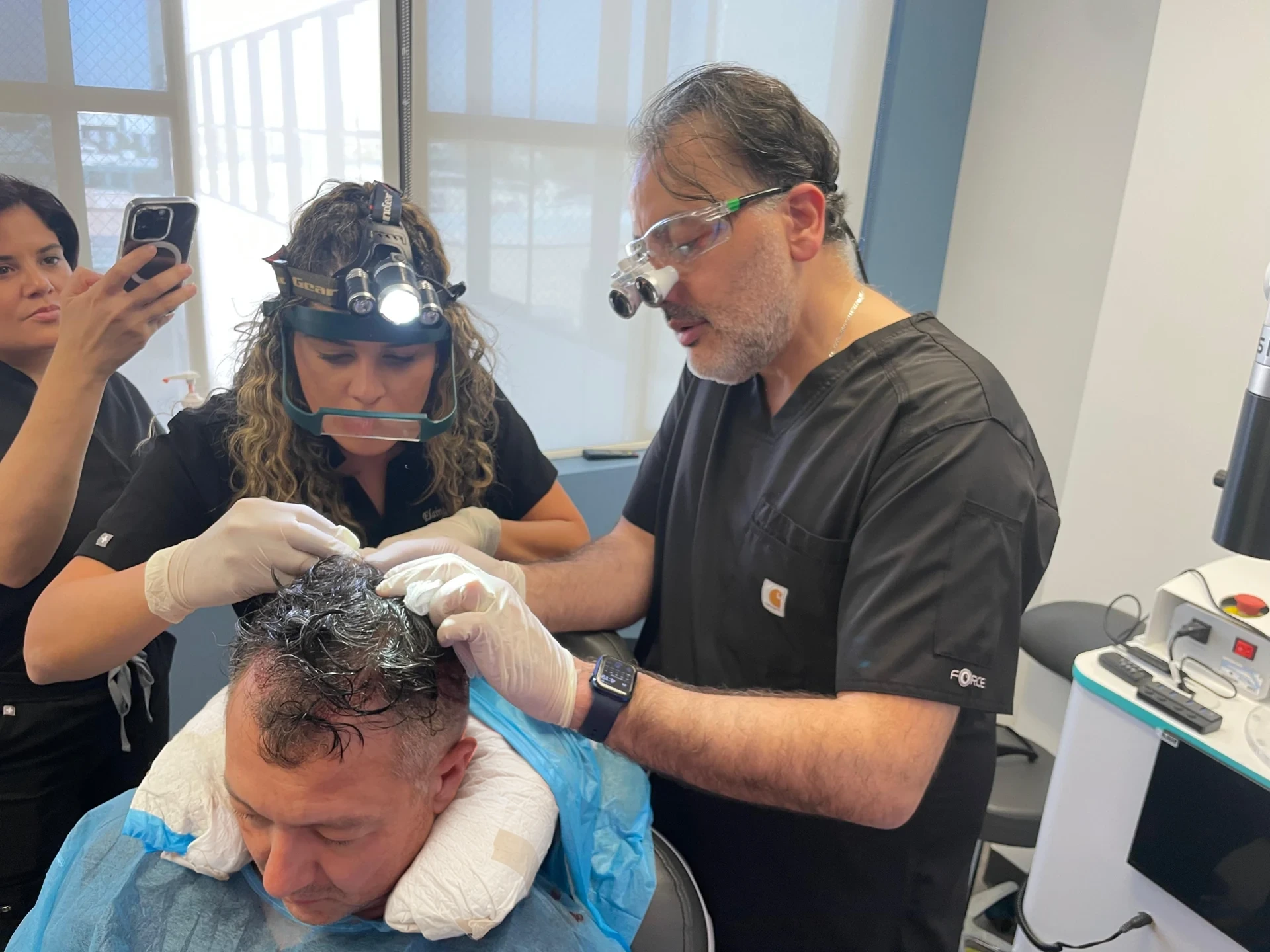
Curriculum
- Hair and scalp anatomy, alopecia assessment and treatment selection
- Consultation, graft planning and hairline design
- Manual, motorized and robot-assisted FUE
- Recipient-site creation, implantation and graft handling
- Non-surgical therapies, genetics and follow-up
- Patient documentation and practice integration
Learning objectives
- Translate a consultation, scalp findings and donor measurements into a defensible long-term graft plan.
- Compare manual, motorized and robot-assisted harvesting in terms of operator decisions, graft handling and documentation.
- Explain how hairline design, recipient distribution and follow-up affect a proposed restoration.
Program outline
Example four-day schedule published for the Buffalo 2025 cohort. Activities and timing for an upcoming session may differ.
Day 1 · Assessment and design
The published example begins with patterns of hair loss and donor selection, followed by hairline and donor marking and an introduction to instruments.
Day 2 · FUE methods and simulation
The example covers candidate selection, harvesting and implantation methods, graft preservation, and device practice on a simulator.
Day 3 · Assisted harvesting and graft handling
Participants observe advanced FUE workflows, practice with equipment, and examine and prepare grafts using magnification.
Day 4 · Implantation and postoperative care
The example concludes with implantation tools, density and hairline planning, supervised procedural participation, follow-up and case discussion.
Preparation
Sketch the donor and recipient regions on a blank scalp diagram. Prepare one question about assessing an area with variable hair caliber or density.
A patient requests a low, dense hairline and has ongoing thinning behind the proposed recipient area. Mark a provisional hairline and priority zones on a diagram. Record what you would measure before estimating graft numbers and how you would explain the trade-offs.
Learning check
Give the patient two planning options. A credible explanation addresses future loss, available donor supply, the limits of a photograph, and the follow-up needed to revise the plan.
Program details
| Course format | Published tuition |
|---|---|
| 4 days | $3,450 (2026) · $3,880 (2027) |
Upcoming cohorts
Advanced Hair Restoration Fellowship
Nov 27–30, 2026 · $3,450 tuition + $86.25 ticket fee
Advanced Hair Restoration Fellowship
Jan 22–25, 2027 · $3,880 tuition + $97 ticket fee
Advanced Hair Restoration Fellowship
Mar 19–22, 2027 · $3,880 tuition + $97 ticket fee
Advanced Hair Restoration Fellowship
May 7–10, 2027 · $3,880 tuition + $97 ticket fee
Advanced Hair Restoration Fellowship
Jul 16–19, 2027 · $3,880 tuition + $97 ticket fee
Advanced Hair Restoration Fellowship
Sep 10–13, 2027 · $3,880 tuition
Advanced Hair Restoration Fellowship
Nov 12–15, 2027 · $3,880 tuition